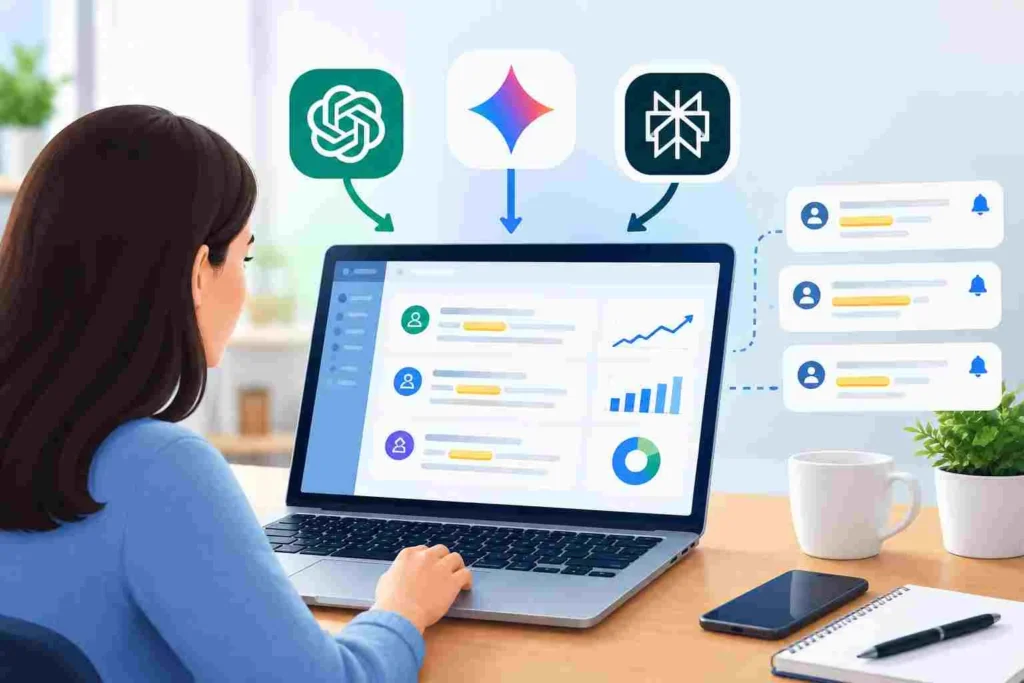
Your customers are changing how they search. Instead of scrolling through ten blue links, many now ask ChatGPT, Google’s AI Overviews, or Perplexity a question and act on the first answer they see. If your business isn’t part of that answer, you’re invisible to a growing group of buyers. An AI SEO audit shows you where you stand and what to fix first. This guide walks you through the process in plain steps, even if you’ve never run an audit before.
What Is an AI SEO Audit?
A traditional SEO audit checks whether your site can rank in search results. An audit built for AI goes a step further. It checks whether AI systems can find your content, understand it, trust it, and quote it when someone asks a question.
The two overlap quite a bit. Fast pages, clean structure, and useful content still matter. What changes is the emphasis: clear answers, consistent business details, and proof that you know your subject. That is the heart of AI search optimization, and it’s where a small business can compete with much bigger brands.
Why Small Businesses Should Care Now
Large companies have teams for this. You probably don’t. But AI-generated answers favor sources that are specific, well organized, and easy to verify, and none of those qualities depend on budget. A local contractor with a detailed service page can easily beat a national directory that says very little.
Waiting has a cost, too. Getting cited early can build momentum, because AI tools keep returning to sources that have already proven useful.
How to Audit a Website for AI Search
Here is the process we follow with clients. Work through it in order and keep notes as you go.
Step 1: Make sure AI crawlers can reach your site. Open your robots.txt file and confirm you aren’t blocking search or AI crawlers by accident. Check that your key pages are indexed in Google and Bing, since many AI tools draw on those indexes. Content hidden behind scripts or login walls may never get seen.
Step 2: Test your current visibility. Ask AI tools the questions your customers ask, such as “Who is the best roofer near me?” Note whether your business appears, which competitors do, and which sources get cited. Save the results as your baseline.
Step 3: Review your content for direct answers. Open each key page and ask whether it answers the main question in the first few sentences. Question-style headings, short paragraphs, and bulleted lists make your content easier to lift into an AI response.
Step 4: Strengthen your trust signals. Add author names, credentials, real reviews, and case studies. Build out your About page with specifics. Remove any claim you can’t back up.
Step 5: Fix the technical basics. Check page speed, mobile usability, HTTPS, and heading structure. Add schema markup, such as LocalBusiness, FAQ, and Article, so machines can read your pages without guessing.
Step 6: Make your business details consistent. Your name, address, and phone number should match everywhere: your site, Google Business Profile, and every directory listing. Mismatches confuse both search engines and AI tools.
Step 7: Review off-site mentions. AI systems look beyond your website. Reviews, local directories, industry listings, and press mentions all shape how trustworthy you appear.
AI SEO Audit Checklist You Can Print
Keep this short list next to you while you work:
• Robots.txt allows search and AI crawlers
• Key pages are indexed in Google and Bing
• Baseline results saved from at least five customer questions
• Every key page opens with a direct answer
• Headings are written as questions or clear topics
• Author, credentials, and reviews are visible
• Schema markup is added and validated
• Name, address, and phone are identical across the web
• Page speed and mobile layout pass basic tests
AI SEO Tools for Small Businesses
You don’t need an expensive software stack to start. Google Search Console and Bing Webmaster Tools are free and show how search engines see your site. Screaming Frog’s free version crawls a small site and flags broken links, missing titles, and heading problems. Google’s Rich Results Test checks your schema.
For AI visibility specifically, manual testing still works well. Run your customer questions through ChatGPT, Gemini, and Perplexity once a month and compare the results. Paid AI SEO tools for small businesses can automate this, but they’re worth considering only after you’ve fixed the basics.
Turn Your Audit Into an AI SEO Strategy
An audit is only useful if it leads to action. A practical AI SEO strategy sorts your findings into three buckets.
First, quick wins: unblock crawlers, correct inconsistent business details, and add missing schema. These take hours, not weeks. Second, content upgrades: rewrite your top service pages so they answer questions directly and show real expertise. Third, authority building: earn reviews, citations, and mentions that prove you’re a trusted name in your area.
Revisit the process every quarter. AI search keeps changing, and a quick recheck keeps you from falling behind.
Common Mistakes to Avoid
Most small businesses stumble in the same few places. They publish thin pages and hope volume will make up for it. They block crawlers without realizing it. They chase every new tool instead of fixing their own content first.
A careful AI SEO audit prevents all three. Remember that AI search optimization rewards clarity over cleverness, so write for the customer asking the question, not for an algorithm.
Need Help With Your AI SEO Audit?
Some owners enjoy doing this themselves. Others would rather spend their time running the business. If that’s you, Pro Construct Digital can handle the audit and build a plan around what we find. We’re a Utah team that works with local businesses every day, so we know what actually moves the needle for small companies.
Call Pro Construct Digital at 801-252-5365 or visit proconstructdigital.com to get started with your AI SEO audit today.