
Most people use the terms “web design” and “web development” interchangeably, but they are two distinctly different disciplines — and confusing the two can lead to costly mistakes when building or upgrading your business website. Whether you are a local business owner searching for custom website design or simply trying to understand what web design is before hiring a professional, this guide breaks down the five key differences in plain language.
At Pro Construct Digital, we help businesses across Utah build high-performing digital presences. Understanding these differences will help you make smarter decisions about your next project — and ask the right questions before you invest.
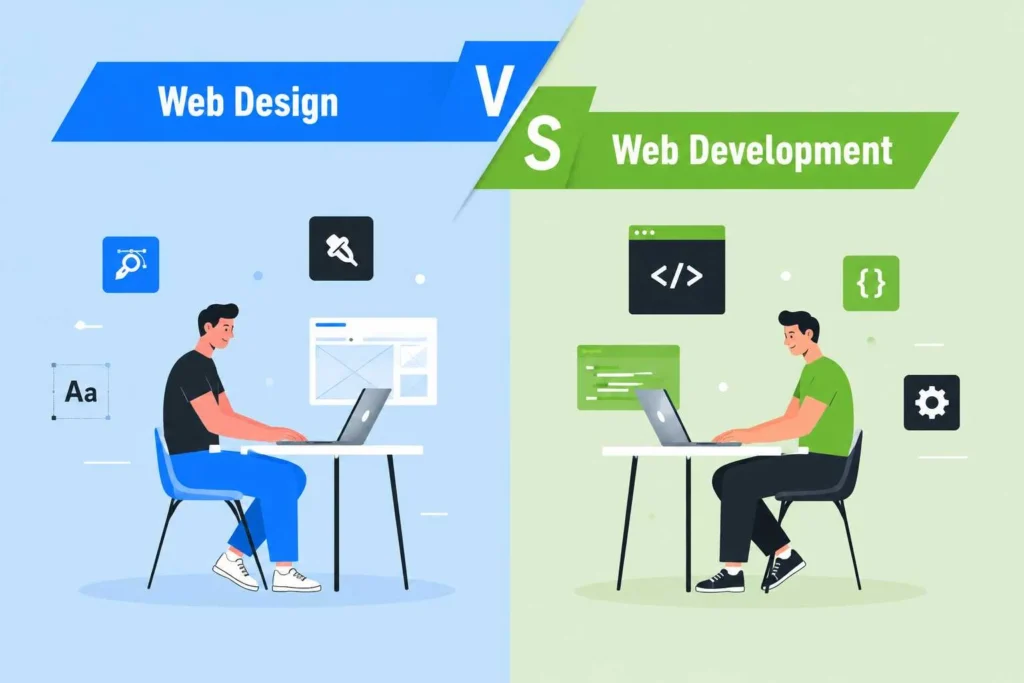
1. What Is Web Design? It Is All About Visual Appearance
So, what is web design, exactly? In simple terms, web design is the process of planning and creating the visual and user-facing elements of a website. This includes everything a visitor sees and interacts with on screen — the layout, color palette, typography, button styles, imagery, and overall aesthetic.
Web designers focus on user experience (UX) and user interface (UI) design. Their primary goal is to create a site that looks professional, loads intuitively, and guides visitors toward a specific action — whether that is filling out a contact form, calling a business, or making a purchase.
For businesses looking for website design, this visual layer is often the first thing that creates a lasting impression. Studies consistently show that users form an opinion about a website within the first 0.05 seconds of visiting it. That means your design needs to communicate credibility, trust, and relevance almost instantly.
Web designers typically work in tools like Adobe XD, Figma, or Sketch to produce wireframes and mockups before a single line of code is written.
2. Web Development Is the Technical Engine Behind the Design
If web design is what a website looks like, web development is what makes it actually work. Web developers take the visual concepts produced by designers and bring them to life through code. There are two primary branches of web development:
Front-end development handles everything the user directly interacts with — the HTML structure, CSS styling, and JavaScript functionality that powers animations, forms, and interactive elements. Front-end developers translate the designer’s mockup into a fully functional browser experience.
Back-end development powers the server-side logic that users never see — databases, user authentication, content management systems, payment processing, and server configurations. When you log into a website, submit a form, or complete a checkout, back-end code is handling everything behind the scenes.
Some professionals specialize in both — commonly called “full-stack” developers — but in agency settings, design and development are often handled by separate specialists to ensure quality at every layer.
3. The Skill Sets Are Fundamentally Different
The tools and skill sets required for web design and web development rarely overlap. This is one of the most important distinctions for business owners to understand when hiring.
Web designers tend to have backgrounds in graphic design, visual communication, or UX research. Their strengths include color theory, typography hierarchy, accessibility standards, brand alignment, and conversion-focused layout design. They think visually and focus on how information is organized and presented.
Web developers, on the other hand, are problem-solvers and programmers. Their expertise includes programming languages such as HTML, CSS, JavaScript, PHP, Python, or frameworks like React and WordPress. They are responsible for performance optimization, security implementation, mobile responsiveness at the code level, and cross-browser compatibility.
When searching for custom website design services, it is worth asking whether the agency you are considering handles both disciplines in-house or outsources one of them. Gaps between design and development handoffs can result in inconsistent output, project delays, and a final product that does not match what was originally proposed.
4. Goals and Success Metrics Differ
Web designers and web developers also measure success differently, which reflects the distinct purposes of each role.
Design success is typically measured by engagement metrics — time on site, bounce rate, click-through rates on calls to action, and overall conversion rate. If visitors are quickly leaving a page or failing to complete desired actions, the design may need to be revisited. Heatmaps, A/B tests, and usability testing are common tools used to evaluate design effectiveness.
Development success is measured by technical performance — page load speed, uptime, security audit scores, Core Web Vitals, mobile responsiveness scores, and database query efficiency. A site can look visually stunning but still rank poorly in search results because slow load times or crawl errors undermine the entire experience.
For website design in Utah County businesses specifically, this distinction matters greatly. Google’s algorithm weighs both design-driven user engagement signals and technical development factors when determining where a site ranks locally. A great-looking site built on a slow, unoptimized foundation will still underperform in local search.
5. The Order of Operations in a Website Project
Understanding how design and development relate in the workflow of a website build is critical for any business planning a new site or website redesign.
In a well-structured project, design always comes first. The design phase includes discovery (understanding your brand, goals, and audience), wireframing (mapping page layouts), and visual design (creating high-fidelity mockups). Client approval is obtained before the development phase begins.
Once the design is finalized, development begins. Developers build the site in a staging environment, integrate any back-end systems, configure hosting and DNS, run QA testing across devices and browsers, and eventually deploy the live site.
When this order is respected, the result is a cohesive product where the visual experience and technical performance work together seamlessly. When these phases are rushed or blurred — for example, building before a design is finalized — the result is typically an inconsistent, inefficient site that requires expensive revisions.
Which Do You Actually Need?
For most small and mid-sized businesses, the answer is both — and you need them to work together. A site that is beautifully designed but poorly developed will load slowly, break on mobile, and fail to rank. A site that is technically solid but visually outdated will drive visitors away within seconds.
At Pro Construct Digital, we integrate both custom website design and professional development into every project. Our team builds websites that are visually sharp, technically sound, and optimized to perform in local search results across Utah County and beyond.
If you are ready to stop losing business to competitors with better websites, we are here to help. Call us today at 801-252-5365 or visit our website to request a free consultation.